
What if your risk register were always up to date, detailed, and actually used by the security practitioners?
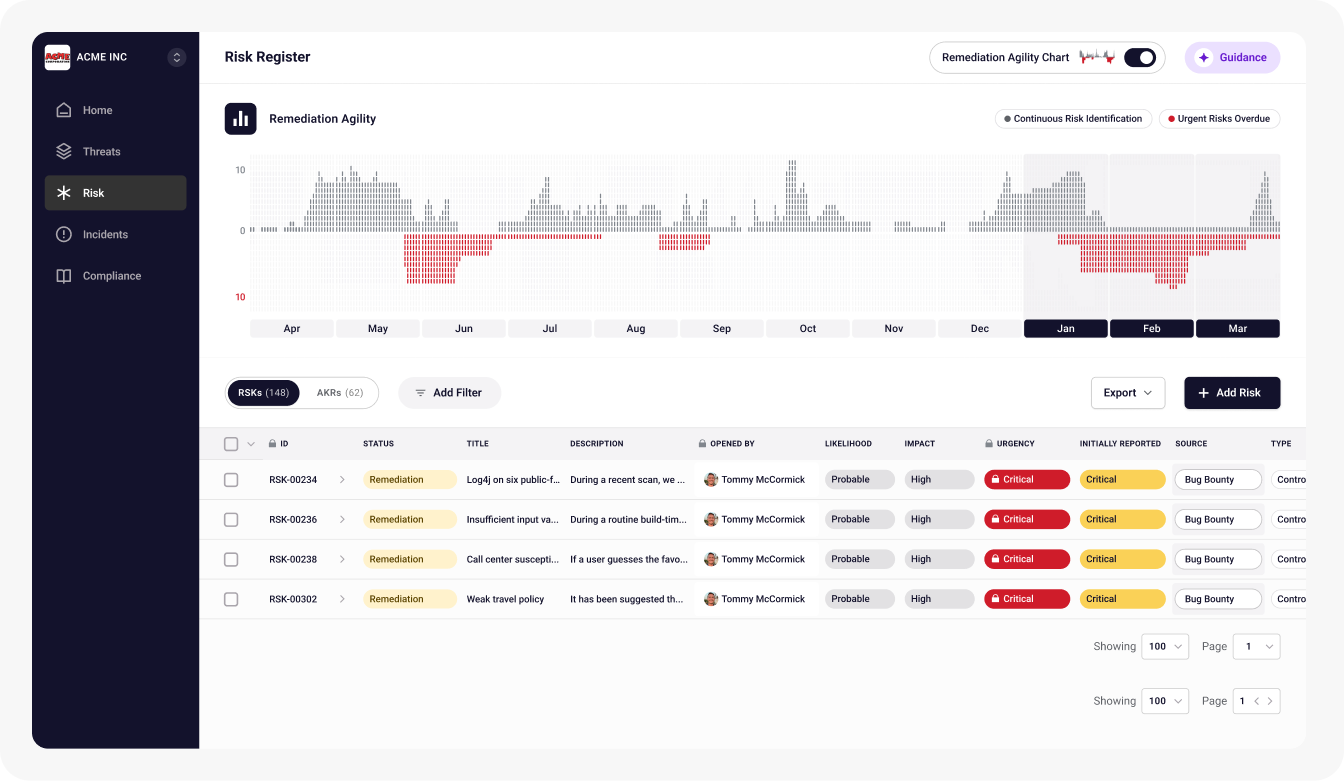
The Intelligent Risk Register™ ingests risks from technical and procedural sources via API, bulk import, or manual entry, and normalizes them into the same vocabulary, the same urgency scoring, the same SLAs, and the same remediation workflows. The rubric is driven by your Risk Assessment Management Procedure (RAMP) — applied by AI in seconds, the same way, every time.
The same workflow across all risk sources.
Threats set the mission; risks drive day-to-day execution. The Intelligent Risk Register™ consolidates findings from vulnerability scanners, cloud posture tools, audit reports, pentests, and bug bounty programs into a single register — then assigns urgency, cuts the remediation ticket, and intelligently polls ticket status to keep the register honest. Switching costs stay minimal even as the underlying tools rotate.
Every finding source, one register
CVEs from the scanners, cloud posture issues, ASM exposures, audit findings, pentest results and bug-bounty submissions all land on the same register. They are not separate programs with separate severities — they are risks, and they get read against the same rubric.
Scored against your own procedure
Likelihood and impact come from the Scoring Guidelines in your RAMP, not from whoever happened to pick up the finding. Discoverability, exposure and exploitability are part of the rubric, and the reasoning behind each rating is written down alongside it.
Tied to the threat profile
A risk matters because of what it lets an adversary accomplish. Each one is mapped to the threat objectives it advances, so ranking reflects your actual threat profile instead of a vendor's generic severity score.
Remediation that closes the loop
The platform cuts the remediation ticket in your existing tracker and polls its status to keep the register honest. Switching costs stay low when the underlying tools rotate, because the register never depended on any one of them.
Measured on velocity, not backlog
Reporting tracks compliance against your own remediation SLAs over time — how fast the gap closes — rather than counting how many tickets are still open. That is the number that belongs in a board deck.