
Extortion
Ransomware, financial sabotage, and extortion-driven attacks
Your Threat Profile underpins downstream decisions. Established at the intersection of our threat intelligence and your business acumen, reviewed quarterly, and used to drive what you will chase, what intelligence is worth filtering for, and what you can defensibly choose not to not panic about.
Cybersecurity isn't one-size-fits-all. Every organization has a different business model, attack surface, and adversary landscape, and the cost of defending everything equally is the same as defending nothing well.
Adversarial structures cyber priorities around six Threat Objectives organized by adversary motivation. Pick the ones that match your business, dismiss the ones that don't, and the rest of the platform follows.
Ransomware, financial sabotage, and extortion-driven attacks
Breaches exposing corporate or customer data
Financial cyber-enabled fraud schemes exploiting business processes
Targeted attacks on critical business operations
Misuse of assets for cryptojacking, botnets, or proxying attacks
Exploiting your platform to attack customers
A Threat Profile is a set of choices, and choices have costs. Chasing nation-state sabotage buys one set of controls; keeping your platform from being turned on your customers buys another. Setting the mission explicitly is what makes those costs arguable — and what makes the decisions you don't take defensible.
Determine what not to chase. Filter intelligence and news to what matters. Defensibly justify the decisions that aren't taken.
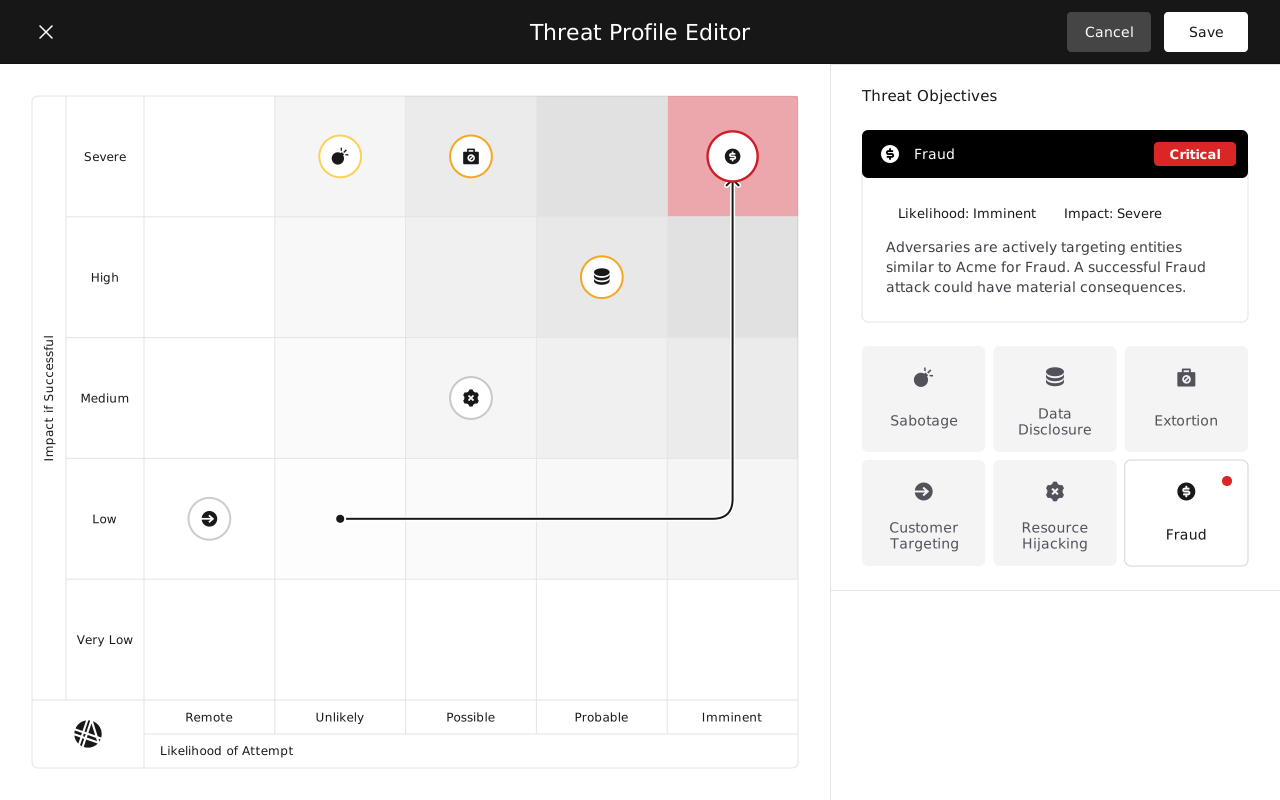
Procedure and policy aren't one-setting-fits-all. Adversarial's governed documents carry alternatives at their decision points — a more permissive stance and a more restrictive one for how a payment is authorized, how far privileged access is locked down, what escalates and when — for you to set according to your risk appetite.
Your Threat Profile is where that appetite is written down. Move an objective and you can see the settings suggested for each of those options, and the reasoning behind them, alongside the ones in force today.
The suggested settings reach for hardware-backed authentication, host-based firewalls, and a stricter travel policy.
They reach somewhere else entirely — CI/CD hardening, privileged access, and software integrity controls.
A recommendation nobody can interrogate is a recommendation CyberGov cannot approve. Each one arrives with the profile it follows from.
A suggestion sits next to the setting in force. Nothing moves inside a governed document without the approval that document already requires.
Adversarial Intelligence
Generic scoring models — CVSS in a vacuum, vendor severity ratings, audit-finding stoplights — don't reflect how real attackers operate, and don't tell you which finding deserves an engineer's attention this sprint.
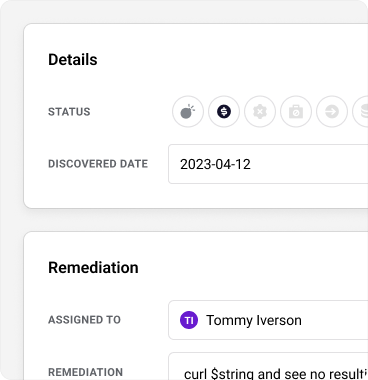
Your Threat Profile is a filter, and Adversarial Intelligence is the integration that runs it. You call out with the profile you've set; we work published threat intelligence against it — reading what's new, judging what bears on your objectives, and writing the result back as ordinary entries in your risk register. Source: Adversarial. Tagged AKR. Initially reported urgency carried over from the Threat Objective it maps to.
From there they behave like every other risk you hold: scored under RAMP by AI or by an analyst, assigned, ticketed, remediated, closed. No parallel inbox, no object only we can touch, and no score you can't overrule.
An entry in the register you already run, carrying where it came from and which Threat Objective earned it a place.
The initially reported urgency comes from your profile, and stops there. RAMP scoring, ownership, and remediation stay yours — AI-assisted or by hand.
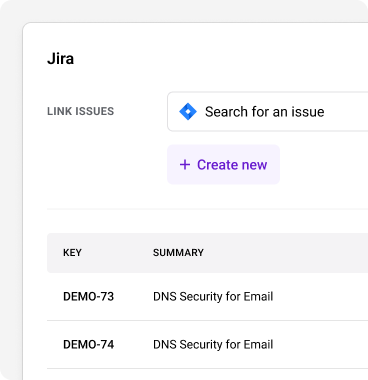
Straight into ServiceNow, Jira, or Linear, where it can be assigned, tracked, and closed like any other work.